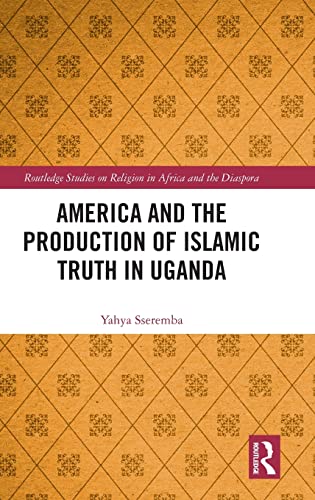
America and the production of Islamic truth in Uganda / Yahya Sse remba.
Material type: TextSeries: Routledge studies on religion in Africa and the diaspora ; 10 London ; New York : Routledge, Taylor & Francis Group, 2023Description: xiii, 187 pages ; 25 cmISBN:
 - 9781032412085
- 9781032412092
- 371.077096761 23
| Item type | Current library | Call number | Status | Barcode | |
|---|---|---|---|---|---|
 Books - Open Access
|
MISR Library - Open Shelves | MISR 371.0770 96761 SSE (Browse shelf(Opens below)) | Available | 001350925 |
Includes bibliographical references and index.
1. Introduction -- 2. Islam and the limits of centralization in late precolonial Buganda -- 3. Exclusion by inclusion: The Ugandan state an d the Muslim subject -- 4. The madrasa as a site of the war on terror - - 5. The diminishing Muslim domain: America's prescriptions for Islamic education reform -- 6. Question formulators and data collectors: the p roduction of knowledge about the madrasa -- 7. Salafism: the boogeyman of the war on terror -- 8. Africa as conceptual model: Ugandan thought and contemporary Islamic reform -- 9. Conclusion: Islam and decoloniza tion.
"This book investigates American intervention in Islamic education i n Uganda during the era of the war on terror. During this period, Musli m education moved from relative autonomy to direct state control and ci vil society scrutiny. During the colonial period, Muslims in Uganda wer e treated as lesser citizens within the Christian-dominated civil spher e. A local system of Islamic education developed with a degree of auton omy that reflected the limits of the colonial state in shaping the Musl im subject. In the subsequent postcolonial period, systems of patronage and clientalistic networks dominated, and Muslim leaders were co-opted by the state, but without much real interference in the day to day liv es of Ugandan Muslims. However, during the war on terror, the US State Department sought to bring the mechanisms of Islamic truth production, especially the madrasa, under direct state control. This book argues th at the separation of the Muslim domain has now come to an end as it is absorbed into civil society, unifying the state's domination of society in the postcolonial era. However, the book also analyses local Ugandan Muslim initiatives to modernise and contextualise their own education and religion and how these initiatives are shaped by and transcend the dominant power. A thorough exploration of US foreign policy and Islamic education, this book will be of interest to students and scholars in t he fields of Political Studies, African Studies and Religious Studies"- - Provided by publisher.
There are no comments on this title.