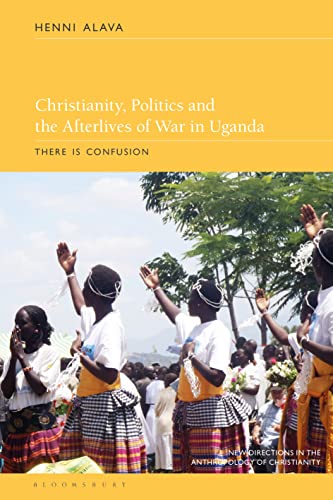
Christianity, politics and the afterlives of war in Uganda : ther e is confusion / Henni Alava.
Material type: TextSeries: New directions in the anthropology of Christianity | New directions in the anthropology of Christianity New York : Bloomsbury Academic, 2022Description: xix, 267 p. ; cmContent type:
 - text
- unmediated
- volume
- 9781350175808
- 261.7096761 23
| Item type | Current library | Call number | Status | Barcode | |
|---|---|---|---|---|---|
 Books - Open Access
|
Main Library - Africana | AF 261.7096 761 ALA (Browse shelf(Opens below)) | Available | 001177286 | |
|
Books - Open Access
|
MISR Library - Open Shelves | MISR 261.7096 761 ALA (Browse shelf(Opens below)) | Available | 001350636 |
Includes bibliographical references and index.
Introduction: Christianity, politics and the afterlives of war in Ac holi - orientations into the field -- The gun and the word: Missionary- colonial history in Kitgum -- Church, state, war -- Learning to listen to silence and confusion -- To stand atop an anthill -- The underside o f the anthill -- 'My peace I give you' -- Confusion in the church -- Co nclusion: The value of embeddedness and confusion.
"This book sheds light on the complex relationships of Christianity, politics, peace and war in Africa and beyond. Drawing on ethnographic fieldwork in Uganda's largest religious communities, it provides a crit ical assessment of the Catholic and Anglican Churches' societal role fo llowing the war between the Lord's Resistance Army and the Government o f Uganda (1986 - 2006). The book shows that Christian narratives of pea ce are entwined in the social, political and material realities within which the churches that profess them are embedded. This embeddedness bo th enables the churches' peace work and sets it insurmountable limits. While churches aim to nurture peace, they themselves are cut up by soci etal divisions, and entrenched in structures of historical violence in ways that make their cries for peace liable to provoke conflict. At the heart of the book is the Acholi concept of anyobanyoba, 'confusion', w hich depicts an experienced sense of both ambivalence and uncertainty; a state of mixed-up affairs within community; and an essential aspect o f politics in a country characterised by the threat of state violence. Building on this local concept, the book also advocates 'confusion' as an epistemological and ethical device"-- Provided by publisher.
There are no comments on this title.