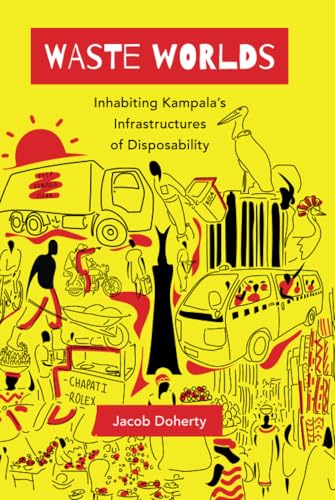
Waste worlds : inhabiting Kampala's infrastructures of disposabil ity / Jacob Doherty.
Material type: TextSeries: Atelier: ethnographic inquiry in the twenty-first century ; 6 | Atelier (Oakland, Calif.) ; 6. Oakland, California : University of California Press, [2022]Description: xix, 267p. ill 29cmISBN:
 - 9780520380943
- 9780520380950
- 363.72/8096761 23
| Item type | Current library | Call number | Status | Barcode | |
|---|---|---|---|---|---|
 Books - Open Access
|
Main Library - Africana | AF 363.7280 96761 DOH (Browse shelf(Opens below)) | Available | 001177322 | |
|
Books - Open Access
|
MISR Library - Open Shelves | MISR 363.7280 96761 DOH (Browse shelf(Opens below)) | Available | 001350603 |
book published out of a Doctoral thesis entitled; 'Infrastructures o f disposability: waste, belonging and the politics of a clean Kampala', 2016
Includes bibliographical references and index.
Preface : "Don't you have garbage in your country?" -- Introduction : disposability's infrastructure -- Accumulations of authority -- Tear gas and trash trucks -- Destructive creation -- Selfies of the state -- Para-sites -- Legalizing waste -- Sink and spill -- Assembling the was te stream -- Embodied displacement -- From natives to locals -- Infra-s tructures of feeling -- Developmental respectability -- Waste in time - - Clean hearts, dirty hands -- Conclusion : surplus, embodiment, displa cement, and contestation.
"Uganda's capital, Kampala, is undergoing dramatic urban transformat ions as its new technocratic government seeks to clean and green the ci ty. Waste Worlds tracks the dynamics of development and disposability u nfolding amid struggles over who and what belongs in the new Kampala. G arbage materializes these struggles. In the densely inhabited social in frastructures in and around the city's waste streams, people, places, a nd things become disposable but conditions of disposability are also ch allenged and undone. Drawing on years of ethnographic research, Jacob D oherty illustrates how waste makes worlds, offering the key interventio n that disposability is best understood not existentially, as a conditi on of social exclusion, but infrastructurally, as a form of injurious s ocial inclusion"-- Provided by publisher.
There are no comments on this title.