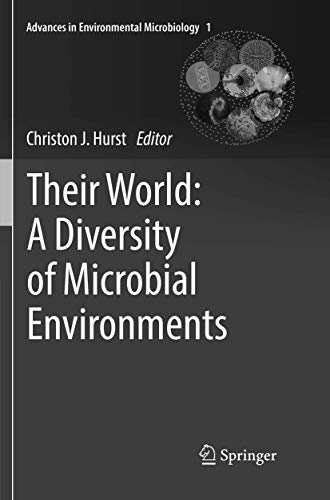
Their World: A Diversity of Microbial Environments / edited by Ch riston J. Hurst.
Material type: TextSeries: Advances in Environmental Microbiology ; 1 Cham : Springer International Publishing : Imprint: Springer, 2016Edition: 1st ed. 2016Description: XV, 381 pages : Ill.( 63 illustrations, 36 illustrations in color ) ; 24cm Media type:
 - computer
- online resource
- 9783319802664
- 9783319280714
- 579.17 23
| Item type | Current library | Call number | Status | Barcode | |
|---|---|---|---|---|---|
 Books - Open Access
|
College of Natural Sciences Library- CONAS | 579.17 TH E (Browse shelf(Opens below)) | Available | 001231388 | |
|
Books - Open Access
|
College of Natural Sciences Library- CONAS | 579.17 TH E (Browse shelf(Opens below)) | Available | 001231387 | |
|
Books - Open Access
|
Main Library - IDA | 579.17 THE (Browse shelf(Opens below)) | Available | 001231389 |
Includes bibbliographical references (p. 367-381)
Towards a unified understanding of evolution, habitat and niche -- D efining the concept of a species physiological boundaries and barriers -- Microbes and the fossil record - selected topics in paleomicrobiolog y -- Endolithic microorganisms and their habitats -- The snotty and the stringy: energy for subsurface life in caves -- Microbiology of the de ep continental biosphere -- Microbiology of the deep subsurface geosphe re and its implications for used nuclear fuel repositories -- Life in h ypersaline environments -- Microbes and the arctic ocean.
This volume summarizes recent advances in environmental microbiology by providing fascinating insights into the diversity of microbial life that exists on our planet. The first two chapters present theoretical perspectives that help to consolidate our understanding of evolution as an adaptive process by which the niche and habitat of each species dev elop in a manner that interconnects individual components of an ecosyst em. This results in communities that function by simultaneously coordin ating their metabolic and physiologic actions. The third contribution a ddresses the fossil record of microorganisms, and the subsequent chapte rs then introduce the microbial life that currently exists in various t errestrial and aquatic ecosystems. Coverage of the geosphere addresses endolithic organisms, life in caves and the deep continental biosphere, including how subsurface microbial life may impact spent nuclear fuel repositories. The discussion of the hydrosphere includes hypersaline en vironments and arctic food chains. By better understanding examples fro m the micro biosphere, we can elucidate the many ways in which the nich es of different species, both large and small, interconnect within the overlapping habitats of this world, which is governed by its microorgan isms.
Description based on publisher-supplied MARC data.
There are no comments on this title.