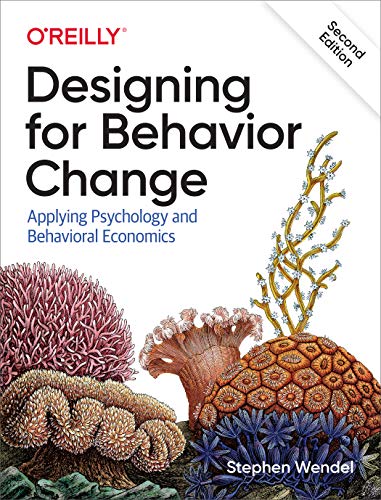
Designing for behavior change : applying psychology and behavioral economics / Stephen Wendel.
Material type: TextPublisher: Beijing ; Sebastopol, CA : O'Reilly, 2020Edition: Second editionDescription: xxiv, 355 pages : illustrations ; 24 cmContent type:
 - text
- unmediated
- volume
- 9781492056034
- 004.019 23
- QA76.9.H85 W456 2020
- Catalography: 20251117 justine.namuddujustine.namuddu
| Item type | Current library | Collection | Call number | Copy number | Status | Barcode | |
|---|---|---|---|---|---|---|---|
 Books - Open Access
|
CHUSS- Psychology Library CHUSS- Psychology Library | Non-fiction | 004.019 STE (Browse shelf(Opens below)) | 1 | Available | 001368211 |
Previous edition: 2013.
Includes bibliographical references (pages 331-344) and index.
Part 1. How the mind works. Deciding and taking action -- Creating action -- Stopping negative actions -- Ethics of behavioral science -- Part 2. A blueprint for behavior change. A summary of the process -- Defining the problem -- Exploring the context -- Understanding our efforts : a brief story about a fish -- Crafting the intervention : cue, reaction, evaluation -- Crafting the intervention: ability, timing, experience -- Crafting the intervention : advanced topics -- Implementing within the product -- Determining impact with A/B tests and experiments -- Determining impact when you can't run an A/B test -- Evaluating next steps -- Part 3. Build your team and make it successful. The state of the field -- What you'll need for your team -- Conclusion.
Designers and managers hope their products become essential for uerse-- integrated into their lives like Instagram, Lyft, and others have become. Such deep integration isn't accidental: it's a process of careful design and iteractive learning, especially at major technology companies. This guide shows you how to apply behavioral science: the interdisciplinary research behind behavior-changing products and communications. In this updated edition, Stephen Wendel, head of behavioral science at Morningstar, takes you step-by-step through the process of incorporating behavioral science into product design and development. Product managers, designers, and data scientists will learn a simple and effective approach to helping your users overcome behavioral obstacles and take action in your product and their lives.
Catalography: 20251117 justine.namuddujustine.namuddu
There are no comments on this title.