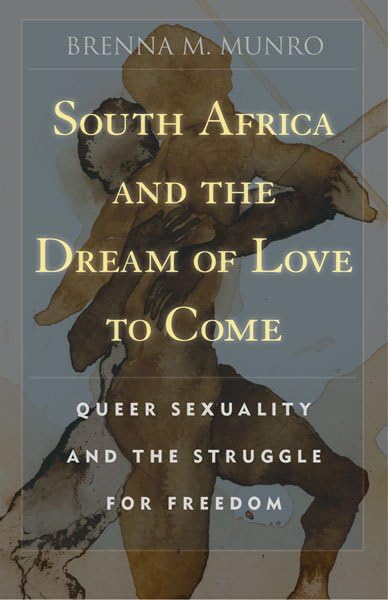
South Africa and the dream of love to come : queer sexuality and the struggle for freedom / Brenna M. Munro.
Material type: TextPublication details: Minneapolis : University of Minnesota Press, c2012.Description: xxxiii, 337 p. : ill. ; 23 cmISBN:
 - 9780816677689 (hardback)
- 9780816677696 (pb)
- 820.9/968 23
- LIT004010 | LIT004160
| Item type | Current library | Call number | Status | Barcode | |
|---|---|---|---|---|---|
 Books - Open Access
|
MISR Library - Open Shelves | 820.9968 MUN (Browse shelf(Opens below)) | Available | 001251011 |
Includes bibliographical references and index.
Machine generated contents note: ContentsIntroduction: The Politics of Stigma and the Making of Democracy -- I. Fraternity and its Anxieti es -- 1. Perverse Institutions, Heroic Genres: Anti-Apartheid Prison Wr iting -- 2. Gay Prison Revisions: Dramas of Conversion -- 3. Border Wri ting: Queering the Fraternity of Whiteness -- II. Gender, Apartheid, an d Imagined Spaces of Nation -- 4. City Sexualities: Richard Rive's Quee r Nostalgia -- 5. Outside the Nation: Bessie Head's Disorientations -- III. Writing the Rainbow Nation -- 6. Queer Family Romance: J.M. Coetze e and Nadine Gordimer -- 7. Queer Citizenship, Queer Exile: K. Sello Du iker and Zanele Muholi -- Conclusion: Unrequited UtopiaAcknowledgments -- Notes -- Bibliography -- Index.
" After apartheid, South Africa established a celebrated new politic al order that imagined the postcolonial nation as belonging equally to the descendents of indigenous people, colonizing settlers, transported slaves, indentured laborers, and immigrants. Its constitution, adopted in 1996, was the first in the world to include gays and lesbians as ful l citizens. Brenna M. Munro examines the stories that were told about s exuality, race, and nation throughout the struggle against apartheid in order to uncover how these narratives ultimately enabled gay people to become imaginable as fellow citizens. She also traces how the gay, les bian, or bisexual person appeared as a stock character in the pageant o f nationhood during the transition to democracy. In the process, she of fers an alternative cultural history of South Africa.Munro asserts that the inclusion of gay people made South Africans feel "modern"--at leas t for a while. Being gay or being lesbian was reimagined in the 1990s a s distinctly South African, but the "newness" that made these sexualiti es apt symbols for a transformed nation can also be understood as forei gn and un-African. Indeed, a Western-style gay identity is often interp reted through the formula "gay equals modernity equals capitalism." As South Africa's reentrance into the global economy has failed to bring p rosperity to the majority of its citizens, homophobic violence has been on the rise.Employing a wide array of texts--including prison memoirs, poetry, plays, television shows, photography, political speeches, and the postapartheid writings of Nobel Laureates Nadine Gordimer and J. M. Coetzee--Munro reports on how contemporary queer activists and artists are declining to remain ambassadors for the "rainbow nation" and refus ing to become scapegoats for the perceived failures of liberation and l iberalism. "-- Provided by publisher.
There are no comments on this title.