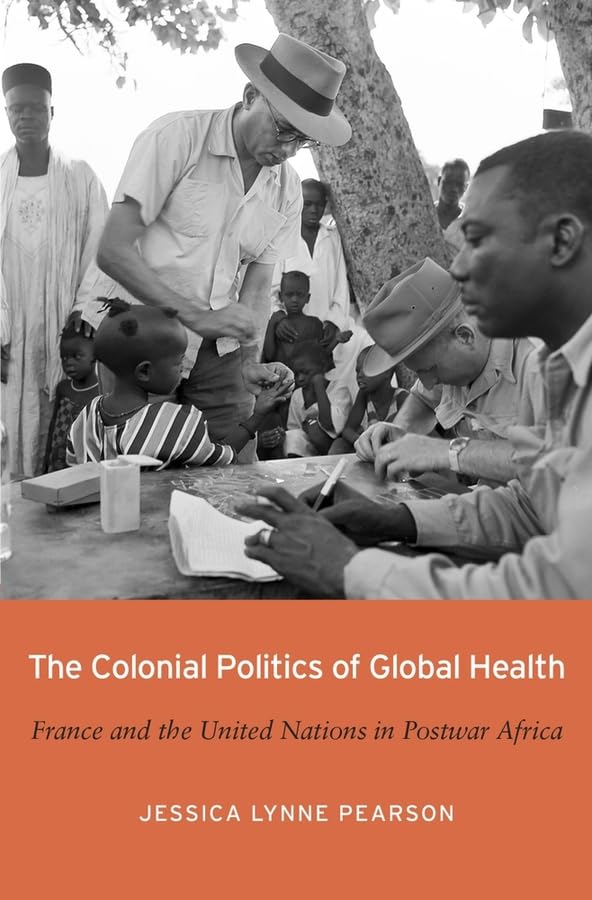
The colonial politics of global health : France and the United Na tions in postwar Africa / Jessica Lynne Pearson.
Material type: Text Cambridge, Massachusetts : Harvard University Press, 2018Description: x, 260 pages : illustrations ; 25 cmISBN:
 - 9780674980488
- United Nations
- Health services administration -- Africa, French-speaking -- History -- 20th century
- Medical policy -- Africa, French-speaking -- History -- 20th century
- Medical care -- Political aspects -- Africa, French-speaking -- Hist ory -- 20th century
- Decolonization -- Africa, French-speaking
- Africa, French-speaking -- Politics and government -- 20th century
- 362.109660917541 23
- 362.109660917541 PEA
| Item type | Current library | Status | Barcode | |
|---|---|---|---|---|
 Books - Open Access
|
MISR Library - Open Shelves | Available | 001350090 |
Includes bibliographical references (pages [227-245) and index.
In The Colonial Politics of Global Health, Jessica Lynne Pearson exp lores the collision between imperial and international visions of healt h and development in French Africa as decolonization movements gained s trength. After World War II, French officials viewed health improvement s as a way to forge a more equitable union between France and its overs eas territories. Through new hospitals, better medicines, and improved public health, French subjects could reimagine themselves as French cit izens. The politics of health also proved vital to the United Nations, however, and conflicts arose when French officials perceived internatio nal development programs sponsored by the UN as a threat to their colon ial authority. French diplomats also feared that anticolonial delegatio ns to the United Nations would use shortcomings in health, education, a nd social development to expose the broader structures of colonial ineq uality. In the face of mounting criticism, they did what they could to keep UN agencies and international health personnel out of Africa, limi ting the access Africans had to global health programs. French personne l marginalized their African colleagues as they mapped out the continen t's sanitary future and negotiated the new rights and responsibilities of French citizenship. The health disparities that resulted offered com pelling evidence that the imperial system of governance should come to an end. Pearson's work links health and medicine to postwar debates ove r sovereignty, empire, and human rights in the developing world. The co nsequences of putting politics above public health continue to play out in constraints placed on international health organizations half a cen tury later.-- Provided by publisher
There are no comments on this title.