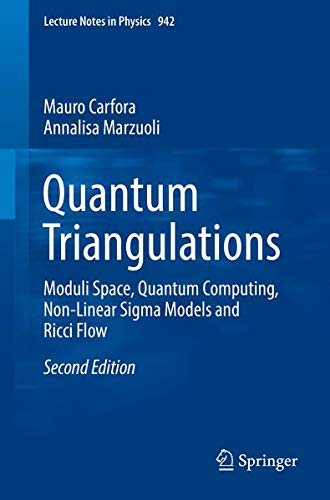
Quantum Triangulations : Moduli Space, Quantum Computing, Non-Lin ear Sigma Models and Ricci Flow / by Mauro Carfora, Annalisa Marzuol i.
Material type: TextSeries: Lecture Notes in Physics ; 942 | Lecture Notes in Physics ; 942 Cham : Springer International Publishing : Imprint: Springer, 2017Edition: 2nd ed. 2017Description: 1 online resource (XX, 392 pages 113 illustrations, 92 illustrations in color.)Content type:
 - text
- computer
- online resource
- 9783319679372
- Complex manifolds
- Gravitation
- Manifolds (Mathematics)
- Mathematical physics
- Physics
- Quantum physics
- Quantum Physics
- Classical and Quantum Gravitation, Relativity Theory
- Manifolds and Cell Complexes (incl. Diff.Topology)
- Mathematical Applications in the Physical Sciences
- Mathematical Physics
- Numerical and Computational Physics, Simulation
- 530.12 23
| Item type | Current library | Call number | Status | Barcode | |
|---|---|---|---|---|---|
 Books - Open Access
|
College of Natural Sciences Library- CONAS | 530.12 CA R (Browse shelf(Opens below)) | Available | 001360305 |
Browsing College of Natural Sciences Library- CONAS shelves Close shelf browser (Hides shelf browser)

|

|

|

|

|

|
|
||
| 530.112 PAR Introduction to the quantum theory / | 530.12 AL T Quantum measurement of a single system / | 530.12 BE L The logic of quantum mechanics / | 530.12 CA R Quantum Triangulations : Moduli Space, Quantum Computing, Non-Lin ear Sigma Models and Ricci Flow / | 530.12 CA S Basic quantum mechanics / | 530.12 CH E Primer of quantum mechanics / | 530.12 CH E Primer of quantum mechanics / |
Preface -- Acknowledgements -- Triangulated Surfaces and Polyhedral Structures -- Singular Euclidean Structures and Riemann Surfaces -- Pol yhedral Surfaces and the Weil-Petersson Form -- The Quantum Geometry of Polyhedral Surfaces: Non-Linear [sigma] Model and Ricci Flow -- The Qu antum Geometry of Polyhedral Surfaces: Variations on Strings and All Th at -- State Sum Models and Observables -- State Sum Models and Observab les -- Combinatorial Framework for Topological Quantum Computing -- App endix A: Riemannian Geometry -- Appendix B: A Capsule of Moduli Space T heory -- Appendix C: Spectral Theory on Polyhedral Surfaces -- Index.
This book discusses key conceptual aspects and explores the connecti on between triangulated manifolds and quantum physics, using a set of c ase studies ranging from moduli space theory to quantum computing to pr ovide an accessible introduction to this topic. Research on polyhedral manifolds often reveals unexpected connections between very distinct as pects of mathematics and physics. In particular, triangulated manifolds play an important role in settings such as Riemann moduli space theory , strings and quantum gravity, topological quantum field theory, conden sed matter physics, critical phenomena and complex systems. Not only do they provide a natural discrete analogue to the smooth manifolds on wh ich physical theories are typically formulated, but their appearance is also often a consequence of an underlying structure that naturally cal ls into play non-trivial aspects of representation theory, complex anal ysis and topology in a way that makes the basic geometric structures of the physical interactions involved clear. This second edition further emphasizes the essential role that triangulations play in modern mathem atical physics, with a new and highly detailed chapter on the geometry of the dilatonic non-linear sigma model and its subtle and many-faceted connection with Ricci flow theory. This connection is treated in depth , pinpointing both the mathematical and physical aspects of the perturb ative embedding of the Ricci flow in the renormalization group flow of non-linear sigma models. The geometry of the dilaton field is discussed from a novel standpoint by using polyhedral manifolds and Riemannian m etric measure spaces, emphasizing their role in connecting non-linear s igma models' effective action to Perelman's energy-functional. No other published account of this matter is so detailed and informative. This new edition also features an expanded appendix on Riemannian geometry, and a rich set of new illustrations to help the reader grasp the more d ifficult points of the theory. The book offers a valuable guide for all mathematicians and theoretical physicists working in the field of quan tum geometry and its applications.
Description based on publisher-supplied MARC data.
There are no comments on this title.