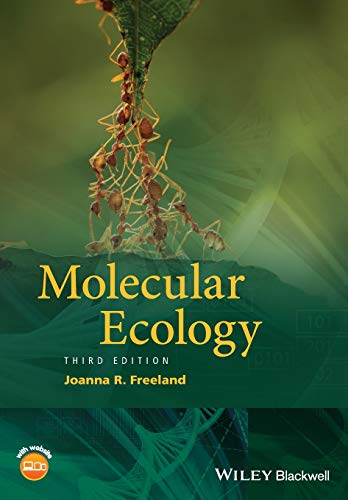
Molecular ecology / Joanna R. Freeland.
Material type: TextPublication details: Hoboken, NJ : Wiley, [2019].Edition: 3rd. editionDescription: xiii, 363 p. : ill. ; 25 cmISBN:
 - 9781119426158
- 577/.14 23
| Item type | Current library | Call number | Status | Barcode | |
|---|---|---|---|---|---|
 Books - Open Access
|
College of Natural Sciences Library- CONAS | 577.14 FR E (Browse shelf(Opens below)) | Available | 001231356 | |
|
Books - Open Access
|
College of Natural Sciences Library- CONAS | 577.14 FR E (Browse shelf(Opens below)) | Available | 001231355 | |
|
Books - Open Access
|
Main Library - IDA | 577.14 FRE (Browse shelf(Opens below)) | Available | 001231357 |
Revised edition of: Molecular ecology by Joanna R. Freeland and Heat her Kirk ; Stephen Petersen. 2nd ed. 2011.
Includes bibliographical references and index.
"Over the past few decades, molecular biology has revolutionized eco logical research. During that time, methods for genetically characteriz ing individuals, populations, and species have developed at a truly imp ressive rate, and continue to provide us with a wealth of novel data an d fascinating new insights into the ecology and evolution of plants, an imals, fungi, algae, and bacteria. Molecular markers allow us, among ot her things, to quantify genetic diversity, track the movements of indiv iduals, measure inbreeding, identify the remains of individuals, charac terize new species, and retrace historical patterns of dispersal. More recently, increasingly sophisticated genomic techniques have provided r emarkable insight into the functioning of different genes, and the ways in which evolutionary adaptations (or lack thereof) can influence the survival of organisms in changing environments. All of these applicatio ns are of great academic interest, and are also frequently used to addr ess practical ecological questions such as which endangered populations are most at risk from inbreeding, or how much hybridization has occurr ed between genetically modified crops and their wild relatives. Every y ear it becomes easier and more cost-effective to acquire molecular gene tic data, and laboratories around the world can now regularly accomplis h previously unthinkable tasks such as describing entire communities ba sed on nothing more than remnant DNA extracted from water samples, or c omparing a suite of functional genes between individuals from different populations"-- Provided by publisher.
There are no comments on this title.