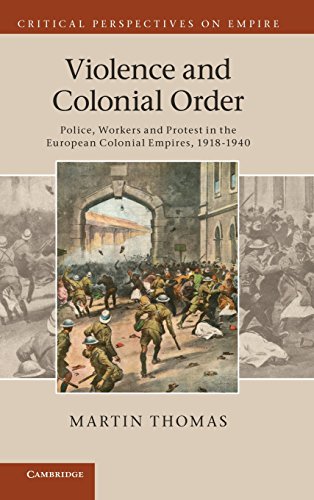
Violence and colonial order : police, workers and protest in the European colonial empires, 1918-1940 / Martin Thomas.
Material type: TextSeries: Critical perspectives on empire Cambridge : Cambridge University Press, 2012Description: xii, 527 pages ; 24 cmContent type:
 - text
- unmediated
- volume
- 9780521768412
- 303.609171/2409041 23
- HIS037070
| Item type | Current library | Call number | Status | Barcode | |
|---|---|---|---|---|---|
 Books - Open Access
|
MISR Library - Open Shelves | 303.609171 TH O (Browse shelf(Opens below)) | Available | 001271646 |
Includes bibliographical references (pages 459-516) and index.
Machine generated contents note: Introduction: Violence and colonial order; Part I. Ideas and Practices: 1. Colonial policing: a discursive framework; 2. 'What did you do in the colonial police force, daddy?'; 3. 'Paying the butcher's bill': policing British colonial protest after 1918; Part II. Colonial Case Studies: British, French and Belgian: 4. Communal policing, policing work, or intelligence gathering? Gendarmes at work in Morocco and Algeria after 1918; 5. Policing Tunisia: minewor kers, fellahs and nationalist protest; 6. Rubber, coolies and communist s: policing disorder in French Vietnam; 7. Stuck together? Rubber produ ction, labour regulation and policing in British Malaya; 8. Caning the workers? Policing and violence in Jamaica's sugar industry; 9. Oil and order: repressive violence in Trinidad's oilfields; 10. Profits, privat ization and police: the birth of Sierra Leone's diamond industry; 11. P olicing and politics in Nigeria: the political economy of indirect rule , 1929-39; 12. Depression and revolt: policing the Belgian Congo; Concl usion.
"This is a pioneering, multi-empire account of the relationship betw een the politics of imperial repression and the economic structures of European colonies between the two World Wars. Ranging across colonial A frica, Southeast Asia and the Caribbean, Martin Thomas explores the str ucture of local police forces, their involvement in colonial labour con trol and the containment of uprisings and dissent. His work sheds new l ight on broader trends in the direction and intent of colonial state re pression. It shows that the management of colonial economies, particula rly in crisis conditions, took precedence over individual imperial powe rs' particular methods of rule in determining the forms and functions o f colonial police actions. The politics of colonial labour thus became central to police work, with the depression years marking a watershed n ot only in local economic conditions but also in the breakdown of the E uropean colonial order more generally"-- Provided by publisher.
There are no comments on this title.