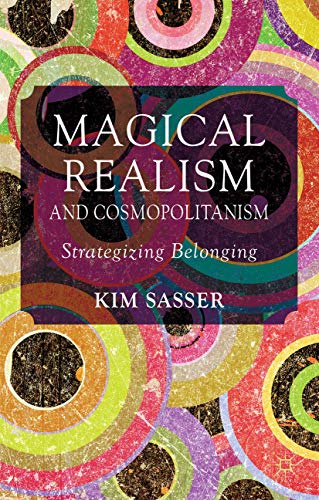
Magical realism and cosmopolitanism : strategizing belonging / Kim Anderson Sasser, Assistant Professor, Wheaton College, USA.
Material type: TextHoundmills, Basingstoke, Hampshire ; New York, NY : Palgrave M acmillan, 2014Description: vii, 260 pages ; 23 cmISBN:
 - 9781137301895 (hardback)
- 809.3/911 23
Includes bibliographical references (pages 237-248) and index.
Machine generated contents note: -- Acknowledgements1.Magical Realis m's Constructive Capacity2.'How Are We to Live in the World?': Cosmopol itan Cartographies 3.Vernacular (Hu)manism in Ben Okri's The Famished R oad4.Universal Cosmopolitanism in Salman Rushdie's The Enchantress of F lorence 5.The Family Nexus in Cristina Garci;a's Dreaming in Cuban6.Unc anny Subjectivity in Helen Oyeymi's The Icarus Girl7.Making a Spectacle of Itself: Magical Realism as Cosmopolitan Form in the Era of Late Glo balizationBibliographyIndex.
"For years, critics have been asking if (and proclaiming that) magic al realism is dead. Has this narrative mode, arguably the most importan t literary movement of the twentieth century, seen its day and become, now, an exhausted and dated form? Magical Realism and Cosmopolitanism e mphatically contends that magical realism still has much to offer conte mporary readers, critics, and authors. However, it has been unnecessari ly limited by hermeneutical approaches that have restricted the form to particular, if significant, historical moments and concerns. Instead, this book argues, magical realism might be re-viewed for its potential to enact a range of potential functionalities. The particular function on which Magical Realism and Cosmopolitanism focuses is magical realism 's capacity to construct sociological representations of belonging, a u sage she traces closely in the late twentieth and early twenty-first ce ntury novels of Ben Okri, Salman Rushdie, Cristina Garcia, and Helen Oy eyemi. In demonstrating magical realism's capacity to strategize belong ing, this book works not only to open up understandings of the mode to new possibilities, but also asks readers to consider ways these narrati ves are employing magical realism to engage contemporary, relevant conc erns. Specifically, Sasser maps the preoccupation with belonging onto c ontemporary cosmopolitanism, that revived interdisciplinary discourse w ithin which belonging is also a central concern, among other questions related to world citizenship. Magical realism, by enfleshing this press ing, renewed concern with belonging within narrative skin, thus demonst rates its continued purchase as a storytelling mode, one for whom the d eath knell need not yet be rung. "-- Provided by publisher.
There are no comments on this title.