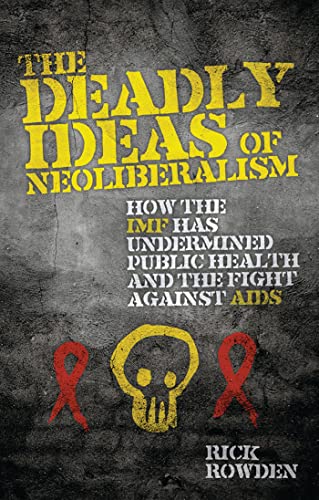
The deadly ideas of neoliberalism : how the IMF has undermined pu blic health and the fight against AIDS / Rick Rowden.
Material type: TextPublication details: London : Zed Books, 2009.Description: 243 p. ; 22 cmISBN:
 - 9781848132856 (pb)
- 1848132859 (pb)
- How the IMF has undermined public health and the fight against AIDS
- How the International Monetary Fund has undermined public health and the fight against AIDS
- International Monetary Fund
- International Monetary Fund
- AIDS (Disease) -- Prevention -- Finance -- Economic aspects -- Devel oping countries
- Neoliberalism -- Economic aspects
- AIDS (Disease) -- Treatment -- Finance -- Economic aspects -- Develo ping countries
- Public health -- Economic aspects -- Developing countries
- Economic assistance -- Developing countries
- 362.196 22
Includes bibliographical references (p. [211]-235) and index.
Introduction --- Part 1. Emergence of HIV/AIDS and the Global Respon se -- 1. The History of Global Funding to Fight HIV/AIDS -- 2. The Impa ct of the AIDS Response on Public Health Systems -- 3. The Shortage of Health Care Workers and the 'Brain Drain' Problem -- 4. The Debate Over 'Vertical' vs. 'Horizontal' Donor Aid -- 5. Different Types of Health Systems, Different Types of Financing -- Part 2 The Neoliberal Developm ent Model -- 6. The Reagan Revolution, Structural Adjustment and The Wa shington Consensus -- 7. Neoliberal Theory and its Policies -- 8. The C onsequences for Development -- Part 3 Consequences for Health -- 9. The Demise of Public Health & Rise of Neoliberalism -- 10. The Consequence s for Health -- 11. 30 Years Later: Coming Full Circle - Rediscovering Public Health -- 12. The IMF: Blocking Progress on Public Health.
"The Deadly Ideas of Neoliberalism explores the history of and curre nt collision between two of the major global phenomena that have charac terized the last 30 years: the spread of HIV/AIDS and other diseases of poverty and the ascendancy of neoliberal economic ideas. The book expl ains not only how IMF policies of restrictive spending have exacerbated public health problems in developing countries, in particular the HIV/ AIDS crisis, but also how such issues cannot be resolved under these ec onomic policies. It also suggests how mounting global frustration about this inability to adequately address HIV/AIDS will ultimately lead to challenges to the dominant neoliberal ideas, as other more effective ec onomic ideas for increasing public spending are sought. In stark, power ful terms, Rowden offers a unique and in-depth critique of development economics, the political economy dynamics of global foreign aid and hea lth institutions, and how these seemingly abstract factors play out in the real world - from the highest levels of global institutions to Afri can finance and health ministries to rural health outposts in the count ryside of developing nations, and back again." -- Publisher's descripti on.
There are no comments on this title.