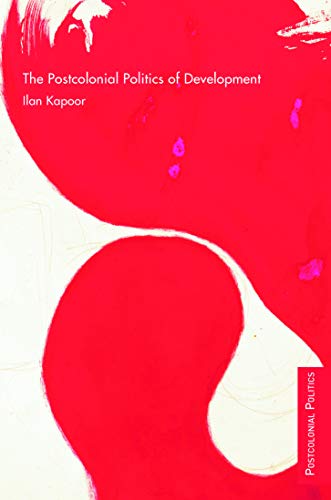
The postcolonial politics of development / Ilan Kapoor.
Material type: TextSeries: Postcolonial politics ; 1Publication details: London ; New York : Routledge, 2008.Description: xvi, 183 p. ; 25 cmISBN:
 - 9780415773980 (pbk.)
- 0415773989 (pbk.)
- 338.90091724 22
Includes bibliographical references (p. 161-177) and index.
Introduction Part 1: Postcolonial Insights?. -- 1. Capitalism, Cultu re, Agency: Dependency versus Postcolonial Theory.- 2. The Culture of D evelopment Policy: Basic Needs, Structural Adjustment, Good Governance and Human Rights.- Part 2: Postcolonial Complicity and Self-Reflexivity ?.- 3. Hyper-Self-Reflexive Development?: Spivak on Representing the Th ird World "Other"?.- 4. Participatory Development, Complicity and Desir e.- 5. Foreign Aid as G(r)ift.- Part 3: Postcolonial Politics?.- 6. Del iberative Democracy or Agonistic Pluralism?: The Relevance of the Haber mas-Mouffe Debate for Third World Politics.- 7. Acting in a Tight Spot: Homi Bhabha's Postcolonial Politics.- 8. Bend it like Bhabha: Hybridit y and Political Strategy.- Conclusion.
"This collection of essays is the first to chart what a specifically 'postcolonial politics' might look like in the context of global devel opment so as to question development's dominant cultural representation s and institutional practices." "The Postcolonial Politics of Developme nt examines recent development policy initiatives in such areas as 'gov ernance', 'human/gender rights', and 'participation' to better understa nd and contest how knowledge is produced in international development - its cultural assumptions and power implications. It shows how we, deve lopment practitioners and westernized elites/intellectuals, are complic it in this knowledge production. Such noble gestures as giving foreign aid or promoting participation and democracy often mask our institution al biases and economic and geopolitical interests, while silencing marg inalized groups, on whose behalf we purportedly work."--BOOK JACKET.
There are no comments on this title.