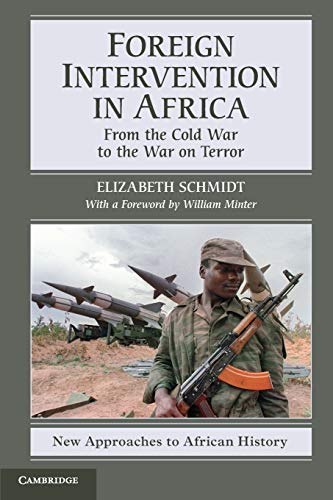
Foreign intervention in Africa : from the Cold War to the War on Terror / Elizabeth Schmidt , Loyola University, Maryland ; foreword by William Minter.
Material type: TextSeries: New approaches to African history ; 7Cambridge : Cambridge University Press, 2013Description: xviii, 267 pages : illustrations, maps ; 24 cmISBN:
 - 9780521709033 (paperback)
- 327.6 22
Includes bibliographical references and index.
Machine generated contents note: Foreword William Minter; Acknowledg ments; Illustrations list; Abbreviations; Introduction; 1. Nationalism, decolonization, and the Cold War (1945-1991); 2. Egypt and Algeria: ra dical nationalism, nonalignment, and external intervention in North Afr ica (1952-1973); 3. The Congo crisis (1960-1965); 4. War and decoloniza tion in Portugal's African empire (1961-1975); 5. White minority rule i n Southern Africa (1960-1990); 6. Conflict in the Horn (1952-1993); 7. France's private African domain (1947-1991); 8. From the Cold War to th e War on Terror (1991-2010); Conclusion; Index.
"Foreign Intervention in Africa chronicles the foreign political and military interventions in Africa during the periods of decolonization (1956-1975) and the Cold War (1945-1991), as well as during the periods of state collapse (1991-2001) and the "global war on terror" (2001-201 0). In the first two periods, the most significant intervention was ext ra-continental. The United States, the Soviet Union, China, Cuba, and t he former colonial powers entangled themselves in countless African con flicts. During the period of state collapse, the most consequential int erventions were intra-continental. African governments, sometimes assis ted by powers outside the continent, supported warlords, dictators, and dissident movements in neighboring countries and fought for control of their neighbors' resources. The global war on terror, like the Cold Wa r, increased the foreign military presence on the African continent and generated external support for repressive governments. In each of thes e cases, external interests altered the dynamics of Africa's internal s truggles, escalating local conflicts into larger conflagrations, with d evastating effects on African peoples"-- Provided by publisher.
There are no comments on this title.