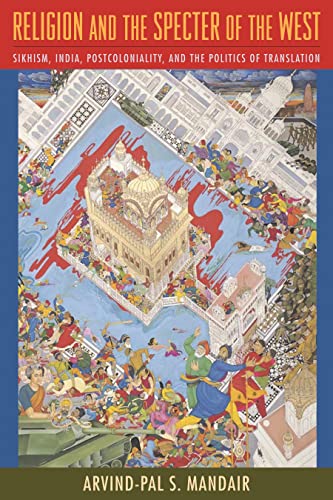
Religion and the specter of the West : Sikhism, India, postcoloni ality, and the politics of translation / Arvind-pal S. Mandair.
Material type: TextSeries: InsurrectionsPublication details: New York : Columbia University Press, c2009.Description: xviii, 516 p. ; 24 cmISBN:
 - 9780231147248 (cloth : alk. paper)
- 0231147244 (cloth : alk. paper)
- Sikhism, India, postcoloniality, and the politics of translation
- 294.6172 23
| Item type | Current library | Call number | Status | Barcode | |
|---|---|---|---|---|---|
 Books - Open Access
|
MISR Library - Open Shelves | 294.6172 MAN (Browse shelf(Opens below)) | Available | 001268814 |
Includes glossary.
Includes bibliographical references and index.
Introduction --- Part I. "Indian Religions" and Western Thought. 1. Mono-theo-lingualism: Religion, Language, and Subjectivity in Colonial North India -- 2. Hegel and the Comparative Imaginary of the West --- P art II. Theology as Cultural Translation. 3. Sikhism and the Politics o f Religion-Making -- 4. Violence, Mysticism, and the Capture of Subject ivity --- Part III. Postcolonial Exits. 5. Ideologies of Sacred Sound - - 6. Decolonizing Postsecular Theory --- Epilogue.
Arguing that intellectual movements, such as deconstruction, postsec ular theory, and political theology, have different implications for cu ltures and societies that live with the debilitating effects of past im perialisms, Arvind Mandair unsettles the politics of knowledge construc tion in which the category of "religion" continues to be central. Throu gh a case study of Sikhism, he launches an extended critique of religio n as a cultural universal. At the same time, he presents a portrait of how certain aspects of Sikh tradition were reinvented as "religion" dur ing the late nineteenth and early twentieth centuries. India's imperial elite subtly recast Sikh tradition as a sui generis religion, which ro bbed its teachings of their political force. In turn, Sikhs began to de fine themselves as a "nation" and a "world religion" that was separate from, but parallel to, the rise of the Indian state and global Hinduism . Rather than investigate these processes in isolation from Europe, Man dair shifts the focus closer to the political history of ideas, thereby recovering part of Europe's repressed colonial memory.
There are no comments on this title.