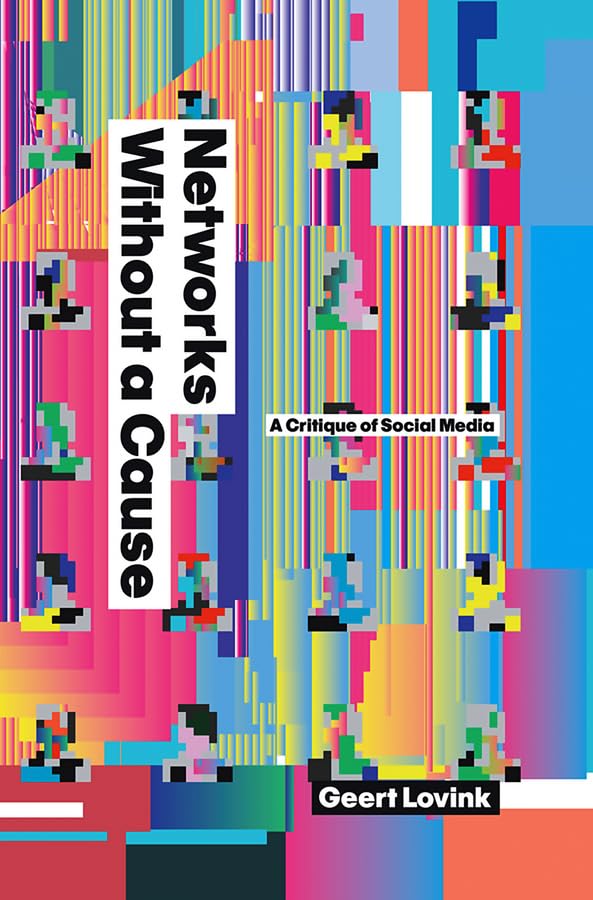
Networks without a cause : a critique of social media / Geert Lovink.
Material type: TextPublication details: Cambridge, UK ; Malden, Mass. : Polity, 2011.Description: vii, 221 p. ; 24 cmISBN:
 - 9780745649672 (hbk.)
- 074564967X (hbk.)
- 9780745649689 (pbk.)
- 0745649688 (pbk.)
- Critique of social media
- 302.30285 23
| Item type | Current library | Call number | Status | Barcode | |
|---|---|---|---|---|---|
 Books - Open Access
|
Main Library - IDA | 302.30285 L OV (Browse shelf(Opens below)) | Available | 001226941 |
Includes bibliographical references (p.213-221).
Introduction: capturing Web 2.0 before its disappearance -- Psychopa thology of information overload -- Facebook, anonymity, and the crisis of the multiple self -- Treatise on comment culture -- Disquisition on Internet criticism -- Media studies: diagnostics of a failed merger -- Blogging after the hype: Germany, France, Iraq -- Radio after radio: fr om pirate to Internet experiments -- Online video aesthetics or the art of watching databases -- Society of the query: the Googlization of our lives -- Organizing networks in culture and politics -- Techno-politic s at WikiLeaks.
With the vast majority of Facebook users caught in a frenzy of 'frie nding', 'liking' and 'commenting', at what point do we pause to grasp t he consequences of our info-saturated lives? What compels us to engage so diligently with social networking systems? Networks Without a Cause examines our collective obsession with identity and self-management cou pled with the fragmentation and information overload endemic to contemp orary online culture. With a dearth of theory on the social and cultura l ramifications of hugely popular online services, Lovink provides a pa th-breaking critical analysis of our over-hyped, networked world with c ase studies on search engines, online video, blogging, digital radio, m edia activism and the Wikileaks saga. This book offers a powerful messa ge to media practitioners and theorists: let us collectively unleash ou r critical capacities to influence technology design and workspaces, ot herwise we will disappear into the cloud. Probing but never pessimistic , Lovink draws from his long history in media research to offer a criti que of the political structures and conceptual powers embedded in the t echnologies that shape our daily lives.
There are no comments on this title.