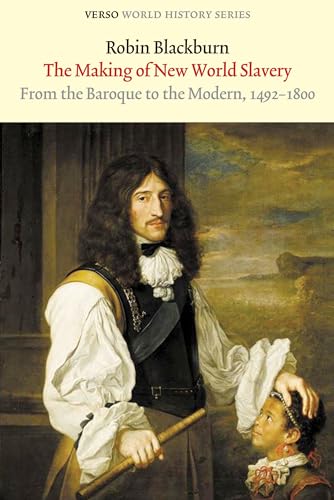
The making of New World slavery : from the Baroque to the Modern, 1492-1800 / Robin Blackburn.
Material type: TextPublication details: London ; New York : Verso, 2010.Description: v, 602 p. : ill. ; 24 cmISBN:
 - 9781844676316 (pbk.)
- 1844676315 (pbk.)
- 306.362097 22
| Item type | Current library | Call number | Status | Barcode | |
|---|---|---|---|---|---|
 Books - Open Access
|
MISR Library - Open Shelves | MISR 306.3620 97 BLA (Browse shelf(Opens below)) | Available | 001141043 |
Originally published: 1997.
Includes bibliographical references and index.
Introduction: Slavery and Modernity ---- Part I. The Selection of Ne w World Slavery. 1. The Old World Background to New World Slavery --- 2 . The First Phase: Portugal and Africa --- 3. Slavery and Spanish Ameri ca --- 4. The Rise of Brazilian Sugar --- 5. The Dutch War for Brazil a nd Africa --- 6. The Making of English Colonial Slavery --- 7. The Cons truction of the French Colonial System --- 8. Racial Slavery and the Ri se of the Plantation ---- part II. Slavery and Accumulation. 9. Colonia l Slavery and the Eighteenth-Century Boom --- 10. The Sugar Islands --- 11. Slavery on the Mainland --- 12. New World Slavery, Primitive Accum ulation and British Industrialization.
"The Making of New World Slavery argues that independent commerce, g eared to burgeoning consumer markets, was the driving force behind the rise of plantation slavery. The baroque state sought -- successfully -- to feed upon this commerce and -- unsuccessfully -- to regulate slaver y and racial relations. To illustrate this history, Blackburn examines the deployment of slaves in the colonial possessions of the Portuguese, the Spanish, the Dutch, the English and the French. Plantation slavery is shown to have emerged from the impulses of civil society, not from the strategies of the individual states. Robin Blackburn argues that th e organization of slave plantations placed the West on a destructive pa th to modernity and that greatly preferable alternatives were both prop osed and rejected. Finally he shows that the surge of Atlantic trade, p redicated on the murderous toil of the plantations, made a decisive con tribution to both the Industrial Revolution and the rise of the West." -- Publisher description.
There are no comments on this title.