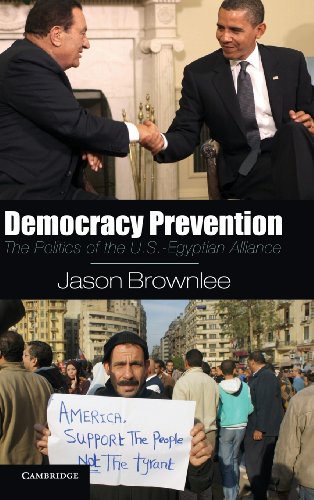
Democracy prevention : the politics of the U.S.-Egyptian alliance / Jason Brownlee.
Material type: TextPublication details: Cambridge [England] New York : Cambridge University Press, 2012.Description: xv, 279 p. : map ; 24 cmISBN:
 - 9781107025714 (hardback)
- 9781107677869 (paperback)
- 327.73062 23
| Item type | Current library | Call number | Status | Barcode | |
|---|---|---|---|---|---|
 Books - Open Access
|
MISR Library - Open Shelves | 327.73062 BRO (Browse shelf(Opens below)) | Available | 001143572 |
Includes bibliographical references (p. 247-265) and index.
"For fifteen years the military regime that took power in Egypt in 1 952 enjoyed a contentious but respectful bilateral relationship with th e United States. After Israel devastated the Egyptian military in the 1 967 War, however, Cairo severed diplomatic ties with Washington. , dipY ears later, compatible strategic aims brought the two governments back together. While Anwar Sadat strove to restore Egypt's territory and sol vency, the White House sought to reduce Soviet influence in the Middle East. A US-Egyptian alliance served both parties, but it took a daring military assault by Sadat to impress the wisdom of the friendship upon the Nixon administration. What followed was one of the most tectonic sh ifts of the Cold War: the complete return of the Sinai Peninsula to Egy pt; a lasting peace between Israel and Egypt, Israel's most formidable regional adversary; and a strategic pact between the United States and Egypt, previously a key client of the Soviet Union. After the Iranian R evolution, Egypt became a component of America's new strategy for prese rving its influence over the Persian Gulf"-- Provided by publisher.
There are no comments on this title.