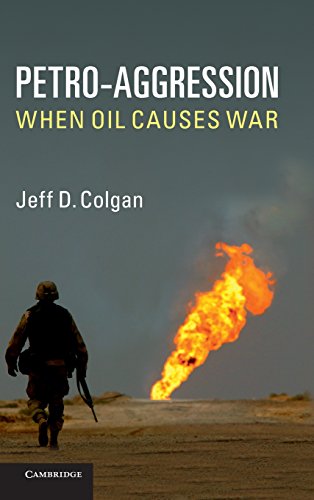
Petro-aggression : when oil causes war / Jeff D. Colgan.
Material type: Text Cambridge : Cambridge University Press, 2013Description: xiv, 312 pages : illustrations ; 23 cmContent type:
 - text
- unmediated
- volume
- 9781107029675 (hardback)
- 9781107654976 (paperback)
- 355.02/73 23
- POL011000
| Item type | Current library | Call number | Status | Barcode | |
|---|---|---|---|---|---|
 Books - Open Access
|
MISR Library - Open Shelves | 355.0273 CO L (Browse shelf(Opens below)) | Available | 001350066 |
Includes bibliographical references (pages 272-291) and index.
Machine generated contents note: 1. Introduction; 2. A theory of oil , revolution, and conflict; 3. Evidence and research design; 4. Quantit ative impact of oil and revolution on conflict; 5. Iraq; 6. Libya and t he Arab Jamahiriyya; 7. Iran; 8. Venezuela and the Bolivarian revolutio n; 9. Saudi Arabia; 10. Does oil cause revolution?; 11. Conclusion and policy implications.
"Oil is the world's single most important commodity and its politica l effects are pervasive. Jeff Colgan extends the idea of the resource c urse into the realm of international relations, exploring how countries form their foreign policy preferences and intentions. Why are some but not all oil-exporting 'petrostates' aggressive? To answer this questio n, a theory of aggressive foreign policy preferences is developed and t hen tested, using both quantitative and qualitative methods. Petro-Aggr ession shows that oil creates incentives that increase a petrostate's a ggression, but also incentives for the opposite. The net effect depends critically on its domestic politics, especially the preferences of its leader. Revolutionary leaders are especially significant. Using case s tudies including Iraq, Iran, Libya, Saudi Arabia and Venezuela, this bo ok offers new insight into why oil politics has a central role in globa l peace and conflict"-- Provided by publisher.
There are no comments on this title.