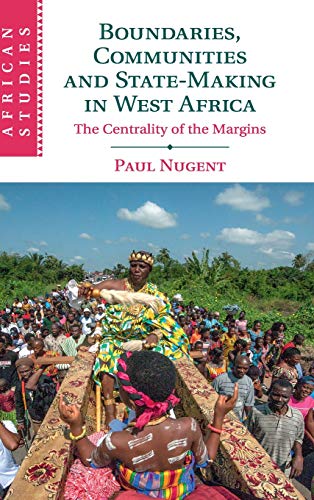
Boundaries, communities, and state-making in West Africa : the ce ntrality of the margins / Paul Nugent.
Material type: TextSeries: African studies series New York, NY : Cambridge University Press, 2019Description: xxiii, 514 p. : ill. ; 22 cmISBN:
 - 9781107020689 (hardback : alk. paper)
- 9781107622500 (pbk. : alk. paper)
- 320.96609 23
| Item type | Current library | Call number | Status | Barcode | |
|---|---|---|---|---|---|
 Books - Open Access
|
CHUSS- Arts Library | 320.96609 NUG (Browse shelf(Opens below)) | Available | 001280655 |
Centering the margins: states, borderlands and communities -- Config urations of power in comparative perspective: commerce, people and beli ef to c.1880 -- Port cities, frontiers and boundaries: spatial lineages of the colonial state -- Constructing the compound, keeping the gate: a fiscal anatomy of colonial state-making, c.1900-1940 -- Being seen li ke a state: frontier logics, colonial administration and traditional au thority in the borderlands -- Border regulation and state-making at the margins: taxation, migration and contraband during the interwar years -- Land, belief and belonging in the borderlands -- Bringing the space back in: decolonization, development and territoriality c.1939-1960 -- The vanishing horizon of Senegambian unity: statist visions and border dynamics -- Forging the nation, contesting the border: identity politic s and border dynamics in the trans-Volta -- Barnacle states and boundar y lines: states, trade and urbanism in the Senegambia -- The remaking o f Ghana and Togo at their common border: Alhaji Kalabule meets Nana Ben z -- Boundaries, communities and 're-membering': festivals and the nego tiation of difference -- Conclusion. Boundaries and state-making: compa risons through time and space.
Border regions are often considered to be the neglected margins. In this book, Paul Nugent argues that through a comparison of the Senegamb ia and the trans-Volta (Ghana/Togo), we can see that the geographical m argins have shaped notional centres at least as much as the reverse. Th rough a study of three centuries of history, this book demonstrates tha t states were forged through an extended process of converting a topogr aphy of settled states and slaving frontiers into colonial borders. It argues that post-colonial states and larger social contracts have been configured very differently as a consequence. It underscores the impact on regional dynamics and the phenomenon of peripheral urbanism. Nugent also addresses the manner in which a variegated sense of community has been forged amongst Mandinka, Jola, Ewe and Agotime populations who ha ve both shaped and been shaped by the border. This is an exercise in re ciprocal comparison and shuttles between scales, from the local and the particular to the national and the regional--Provided by publisher.
There are no comments on this title.