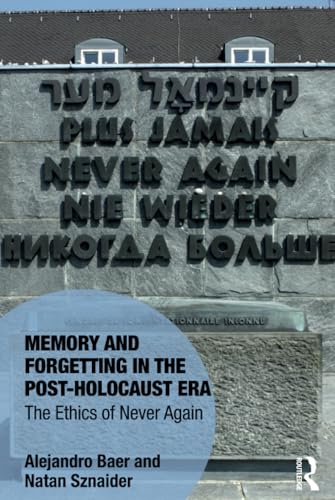
Memory and forgetting in the post-Holocaust era : the ethics of n ever again / Alejandro Baer and Natan Sznaider.
Material type: TextSeries: Memory studies: global constellationsLondon ; New York, NY : Routledge/Taylor & Francis Group, 2 017Description: viii, 173 pages : illustrations ; 24 cmISBN:
 - 9781472448941
- Holocaust, Jewish (1939-1945) -- Argentina -- Public opinion
- Holocaust, Jewish (1939-1945) -- Spain -- Public opinion
- Holocaust, Jewish (1939-1945) -- Europe, Eastern -- Public opinion
- Public opinion -- Argentina
- Public opinion -- Spain
- Public opinion -- Europe, Eastern
- Collective memory -- Argentina
- Collective memory -- Spain
- Collective memory -- Europe, Eastern
- Genocide -- Case studies
- Crimes against humanity -- Case studies
- 179.7 23
- 179.7 BAE
Includes bibliographical references and index.
Ethics of never again: global constellations -- Nunca Mas: Argentine nazis and Judios del Sur -- The disappeared of the Spanish Holocaust - - Competing memories in Eastern Europe -- Conclusion: towards a memory of hope.
"The study of memory is too often pervaded with a spatially-fixed un derstanding of culture. The idea of culture as 'rooted' was an attempt to provide a solution to the uprooting of local cultures caused by the formation of nation-states. Conversely, Sznaider and Baer contend that there exist travelling/cosmopolitan or multi-directional memories, base d on experiences originating in a specific place, but which move and tr avel from there to other ones. Using the Holocaust as an example, the a uthors show how memories of it are disseminated and how they become par t of a larger global framework. There are four ways the Holocaust can b e universalized: was it the Jews, or many different peoples that suffer ed? Is the lesson 'never again', for the Jews, or for everyone? Were th e Nazis uniquely evil, or only different in quantity from other mass mu rderers? Who remembers and who has the right to pronounce the truth of the Holocaust? Taking Argentina and Spain as test cases and looking at public media, scholarly discourse, NGOs dealing with human rights and m emory, museums and memorial sites, this book follows these four ways of universalization to illustrate the transformation from the national to the cosmopolitan ethics of overcoming the past. Both case-studies show that this ethics is not only pertinent to Europe and the places that a re directly related to the Holocaust, but proves that that memory does indeed travel."--Provided by publisher.
There are no comments on this title.